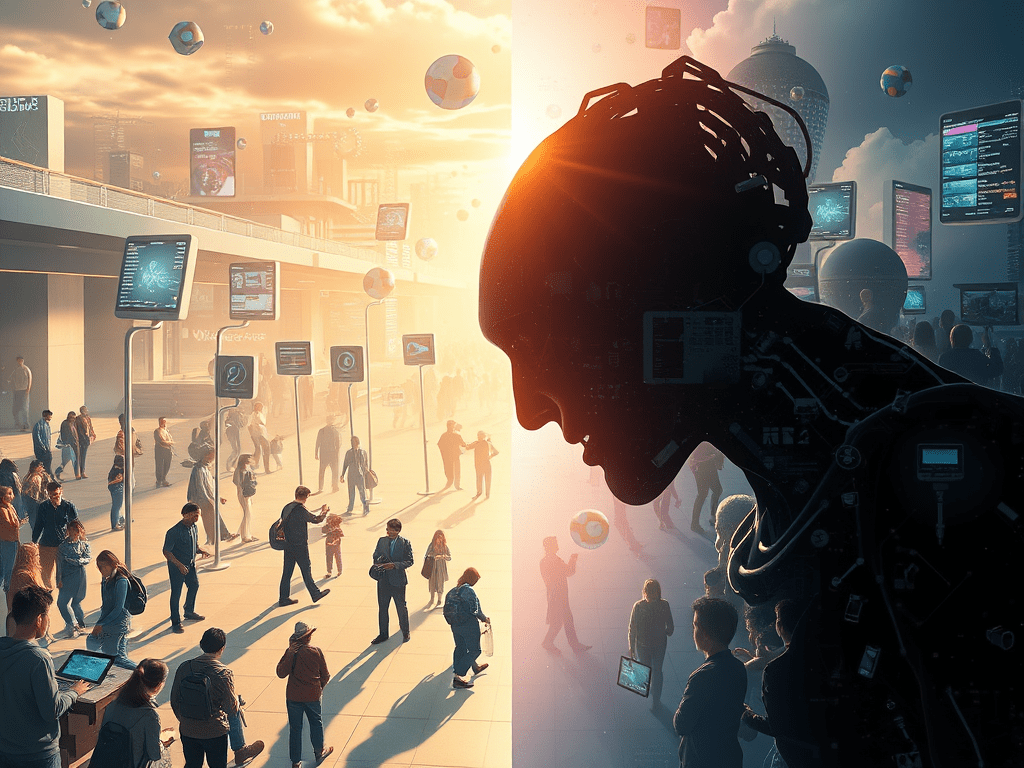
Artificial Intelligence has already reshaped the modern world.
It has improved lives — automating boring work, unlocking creativity, and speeding up learning — yet it has also introduced deep uncertainty. Deepfakes, bias, misinformation, and the potential for mass manipulation have all become part of the new digital vocabulary.
Like every revolutionary technology before it, AI is both a gift and a warning. The real question is: how will people, businesses, and governments adapt to this new era — and at what cost?
The Human Dilemma: Life Support and the Limits of Technology
Before diving into the AI debate, let’s pause for a moment on an equally difficult question:
What do we do about people on life support, trapped in a vegetative state?
It’s a moral puzzle that technology itself helped create.
Machines can now preserve the body almost indefinitely, but not always the person inside. My personal stance is that decisions should always center on the patient’s values and dignity.
If there’s hope of recovery, give time and compassion.
If there’s none, we must have the courage to let go.
Technology should serve life, not trap it in perpetual limbo.
That lesson echoes into the AI era too: just because we can, doesn’t always mean we should.
How People, Businesses, and Governments Are Adapting
People
Ordinary users are learning to coexist with AI in their daily routines — using it to plan meals, organize their days, and even generate new ideas.
But the real skill isn’t how fast you can prompt ChatGPT — it’s how well you can judge and verify what it gives you.
AI can enhance productivity, but if you outsource all your thinking, it quietly erodes your ability to focus, reason, and reflect.
It can make you faster — but not necessarily wiser.
Businesses
Companies are integrating AI into customer service, marketing, coding, and data analysis. It’s not just about replacing workers; it’s about redesigning workflows.
The smart companies are the ones using AI to handle high-volume, low-risk tasks first — freeing humans to focus on creativity, negotiation, and emotional intelligence.
Governments
Governments are walking a fine line. On one hand, they’re modernizing — using AI for public services and policy analysis. On the other, they’re racing to regulate the very thing they depend on.
AI policy now balances innovation and control, with rising concerns about surveillance, misinformation, and algorithmic bias.
And that brings us to a darker side of the story.
Dystopia vs. Utopia: The Dual Future of AI
The truth is, we’ll get both.
The Dystopian Future
- Information chaos — we won’t know what’s real anymore.
- Automation inequality — big companies and rich nations benefit first, widening the gap.
- Surveillance expansion — our “personal AIs” could become Trojan horses feeding data to unseen servers.
- Underground AIs — unregulated, uncensored, and capable of harm.
The Utopian Future
- Universal access to knowledge — every child, artist, or entrepreneur has a tireless assistant.
- Frictionless translation and accessibility — language, disability, and geography no longer divide us.
- Scientific acceleration — breakthroughs in health, environment, and education happen faster.
- Smarter governance — governments use AI to explain laws, translate policy, and respond faster to citizens.
The line between dystopia and utopia will depend on one thing:
how responsibly we design incentives, laws, and verification systems.
Popular vs. Truth: The New War for Trust
We live in an age where popularity often beats accuracy.
Algorithms reward engagement — not truth. AI can amplify confident misinformation faster than any human fact-checker.
So how do we fight back? By rebuilding our trust hierarchy:
- Provenance: Who said it?
- Date: When was it written?
- Evidence: How do they know?
- Accountability: Who stands behind it?
- Counterpoint: Did they consider the other side?
In the end, truth-checking will become as essential as spell-checking.
What Smartphones Taught Us About AI
When smartphones arrived in the 2000s, people expected convenience — not transformation.
We got both.
What we expected
- Easier communication
- Maps, cameras, productivity apps
What we didn’t expect
- Social media addiction and mental health crises
- The attention economy, built on notifications
- Gig work that redefined labor
- Mass surveillance and targeted ads
The same will happen with AI. The biggest shocks won’t come from what it does — but from how humanity reorganizes around it.
Open Source vs. Closed Source AI
Right now, AI comes in two flavors:
- Open Source AI: Cheaper, customizable, transparent — but riskier.
- Closed Source AI: Safer, more powerful — but controlled by big corporations.
In the future, we’ll see hybrids. Companies will use private open models for internal data and rent closed ones for complex reasoning.
The real battle will be about who controls the data — and who audits the truth.
The Rise of Underground AI
As official models stay tied to government pledges and safety contracts, unregulated models will rise.
These underground versions will ignore content filters, answer banned questions, and operate in moral grey zones.
The solution isn’t censorship — it’s better design and education.
When people understand AI deeply, they rely less on unsafe versions.
AI and Privacy: The Surveillance Question
Every device, app, and AI tool collects data.
So we must ask: how much can governments see?
Anything synced to the cloud can, in theory, be subpoenaed or accessed through legal channels.
To stay private:
- Use on-device or self-hosted AI for personal data.
- Disable “training on your data” when possible.
- Check the company’s data retention policy.
- Keep your own data map: what’s stored, where, and for how long.
Privacy in the AI age isn’t about hiding — it’s about managing exposure intelligently.
Is AI Making Us Smarter or Dumber?
AI boosts efficiency — but over-reliance can make you mentally lazy.
Real intelligence requires friction: struggling through a problem, recalling facts, forming opinions.
The balance:
- Use AI to enhance, not replace.
- Do reps manually — write, code, or think without it sometimes.
- Verify and paraphrase — don’t just copy outputs.
- Maintain health routines — physical and mental clarity matter more than ever.
The goal is not to outsource thinking, but to amplify it.
How Humanity Can Survive and Thrive
Individuals
- Verify everything twice.
- Keep local and cloud models separate.
- Learn how to write, think, and prompt — those skills will never expire.
Teams
- Redesign workflows, don’t just sprinkle AI in.
- Track quality metrics and errors.
- Treat AI mishaps like cybersecurity incidents — learn and adapt.
Governments & Institutions
- Publish transparent “AI nutrition labels.”
- Fund public datasets and open research.
- Teach citizens to think critically — not just consume content.
Conclusion: Between Power and Responsibility
The future of AI isn’t written by engineers — it’s written by how we use it.
It will bring moments of brilliance and moments of fear.
It will make life easier — and sometimes emptier.
AI can give us speed, but only we can give meaning.
It can process knowledge, but only we can choose wisdom.
The challenge of this century isn’t building smarter machines —
it’s ensuring humans stay worthy of them.
 The Krisana
Leave a comment