Few issues in modern British politics generate as much discussion as immigration and housing. Rising rents, expensive house prices, and growing waiting lists have led many people to ask whether migration is the primary cause of Britain’s housing crisis. Yet the reality is far more complex than a single statistic or political slogan.
One of the most overlooked aspects of the migration debate is emigration. Public discussion often focuses on the number of people arriving in the United Kingdom, but far less attention is paid to the number of people leaving. While immigration remains high, hundreds of thousands of people also emigrate each year. The more meaningful figure is net migration—the difference between arrivals and departures—which provides a clearer picture of how migration contributes to population growth.
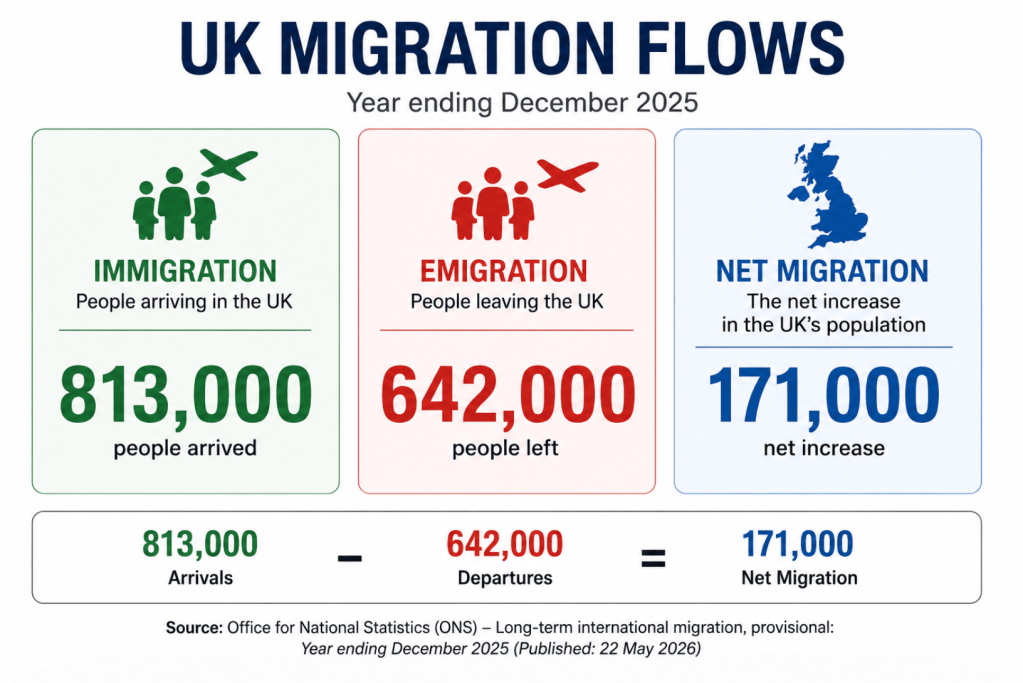
Migration itself is also more diverse than it is often portrayed. Public attention frequently focuses on illegal migration and small boat crossings, but these represent only one part of a much larger picture. Migrants arrive in Britain for many different reasons, including higher education, skilled employment, family reunification, and humanitarian protection. International students, healthcare workers, engineers, scientists, and other skilled professionals form a significant portion of modern migration flows. Understanding who is arriving is just as important as understanding how many arrive.
However, even if migration were significantly reduced, Britain would still face substantial housing challenges. The country has struggled to build enough homes for decades. In the post-war period, Britain regularly built hundreds of thousands of homes each year. Over time, housing construction fell while the population continued to grow and household formation changed. Today, more people live alone, marriages occur later, and households are generally smaller than they were in previous generations. As a result, housing demand has risen even faster than population growth alone would suggest.
This creates a difficult policy dilemma. Many developed countries are concerned about declining birth rates and ageing populations. Nations such as Japan, South Korea, and Italy demonstrate the economic challenges that can arise when populations age rapidly. Fewer workers must support more retirees, placing greater pressure on pensions, healthcare systems, and public finances.
For this reason, governments often seek policies that encourage population growth, whether through higher birth rates, immigration, or both. A larger working-age population can help support economic growth, increase tax revenues, and sustain public services. Yet population growth also increases demand for housing, transport, healthcare, schools, and infrastructure. If supply fails to keep pace, the benefits of growth can be overshadowed by rising costs and declining affordability.
The housing debate therefore cannot be separated from the broader question of national planning. Building more homes is not simply a matter of deciding to construct them. Britain must also balance development with environmental protection. Many people support increased housing construction in principle while simultaneously wishing to preserve countryside, green spaces, wildlife habitats, and the character of local communities. These concerns are legitimate and reflect a genuine tension between development and conservation.
The challenge is not merely to build more homes, but to build the right homes in the right places while maintaining a balance between economic growth, environmental protection, and quality of life.
Housing itself is only one part of the equation. Every additional household requires supporting infrastructure. New homes place demands on roads, public transport, hospitals, schools, GP surgeries, water supplies, energy networks, and local services. Successful population growth depends not only on housing construction but on the expansion of the wider systems that allow communities to function effectively.
This complexity helps explain why the immigration debate has become so polarised. Those concerned about immigration often point to housing shortages, rising rents, and pressure on public services. Those who support higher levels of migration often highlight economic growth, labour market needs, demographic challenges, and tax revenues. Both sides are responding to real issues. The disagreement is often less about the facts themselves and more about which facts should carry the greatest weight.
Ultimately, Britain’s housing challenge is not the result of a single policy, a single government, or a single cause. It is the product of long-term demographic, economic, and planning decisions that have accumulated over decades. Immigration contributes to housing demand, but so do population growth, smaller households, infrastructure constraints, and years of underbuilding.
The real question facing Britain is not whether it should choose population growth or housing supply. It is whether the country can successfully ensure that the two grow together. A growing population can be an economic strength. A housing shortage can become an economic weakness. The challenge for policymakers is ensuring that one does not undermine the other.
The future of Britain’s housing market will depend not on finding a simple scapegoat, but on confronting the complex reality that prosperity, population growth, environmental protection, and housing supply must all be managed together. Only then can the country hope to create a housing system that is both affordable and sustainable for future generations.
 The Krisana
Leave a comment